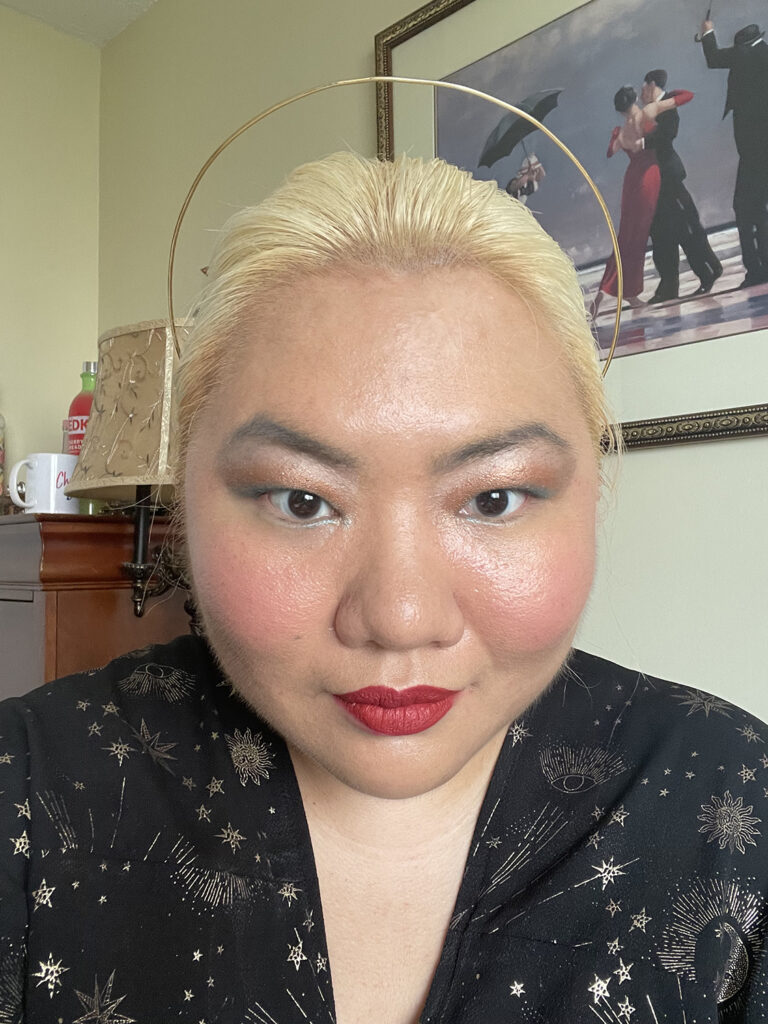
As I experiment with more looks, I become more comfortable with myself. Staring at my face as a canvas forces me to think of makeup as paint and myself as art. I remember the techniques: shade the receding curves, lighten to highlight, let the colors complement and not compete. This is not my final look but I finally feel like I’m getting close. The eyebrows need more work and the lips maybe need to be less bold. But I still have a few weeks to decide.
I have thought so long and hard about I look, how to shape my face, how to make myself acceptable – or rather beautiful – for other people. But the feminist in me counters: Do I really need other people to think I’m beautiful?
What is beauty anyway?
So much has been written on beauty but very few dare define what it is. Plato described beauty as not just of the physical form but also of the mind and soul. The Stoics linked beauty to moral goodness, a view that still lingers today in the 21st century. Aquinas said that beauty is what gives pleasure while seen. Kant described beauty only in our reaction to it: an immediate experience without concept, rational thought, emotion or interest in the beautiful object. So far, beauty is shapely, morally good, pleasurable, and, perhaps most controversially, instinctually recognized.
But the question remains: What is beauty?
Is it phi, the golden ratio? Alas, no. Many attempts to link beauty to the golden ratio have failed, as phi is not as ubiquitous, natural, or divine as many may think and many studies have also failed to link human perception of beauty with phi. Is beauty even objective? Does beauty exist outside outside the human mind? Is beauty biological? Can we, in the famous words of Potter Stewart, know beauty when we see it? Or maybe is beauty a social construct, existing as an arbitrarily agreed upon collection of attributes? Finally, perhaps, is beauty, as Margaret Wolfe Hunger wrote, “in the eye of the beholder”?
There is evidence that facial traits people find beautiful is subjective. Also, there is evidence that people find faces more beautiful when they are told that the faces are more beautiful. Not only is beauty not universal, beauty is a social phenomenon.
We all need to feel beautiful and attractive, but perhaps that validation only matters from the people who matter. When I asked John how my look looks, he replied, “You look stunning.” And I suppose that’s the only opinion that should be important.
Leave a Reply